Determining optimal angles needed for sinogram classification
Denver Bradley
db402@duke.edu
| Paper PDF |
|
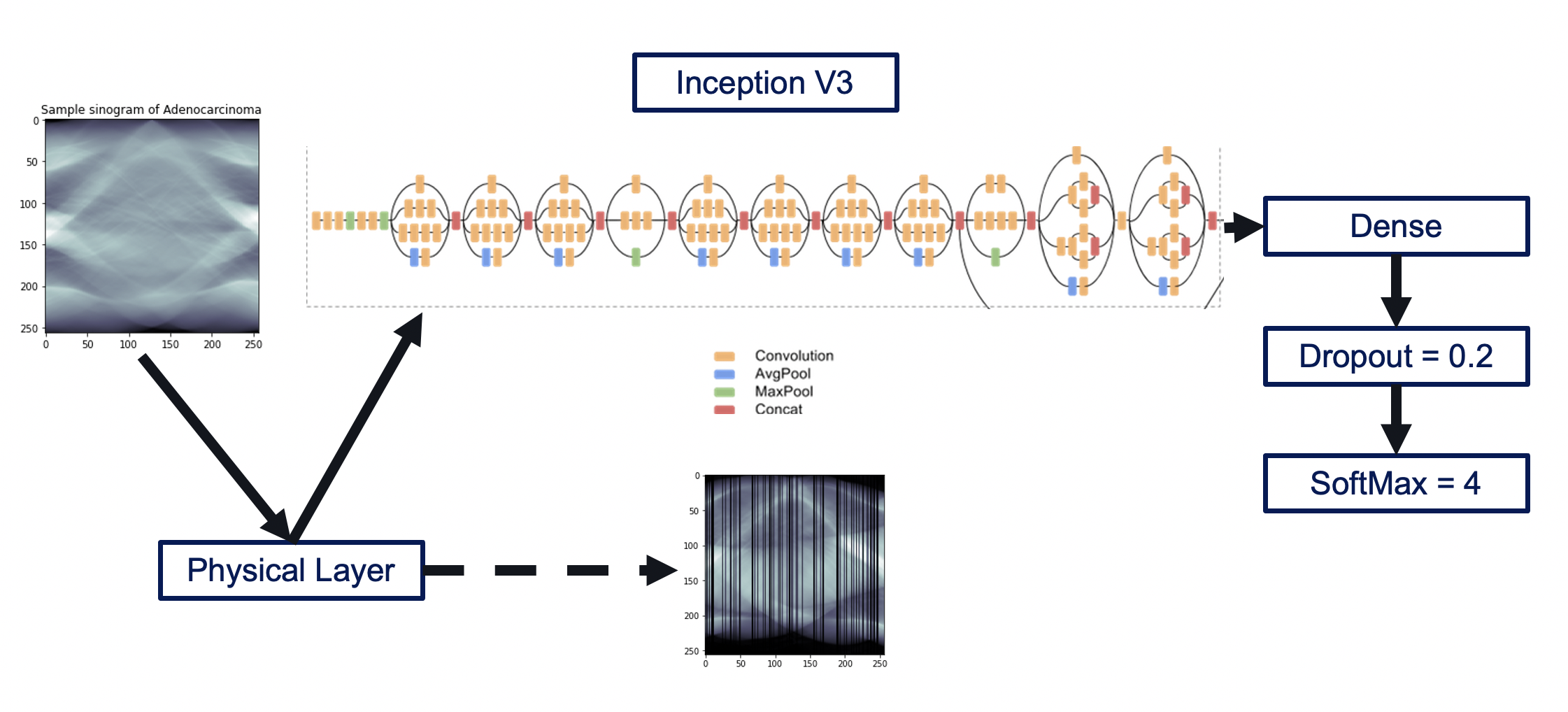
The American Cancer Society predicts that lung cancer will be the deadliest cancer and second most common type of cancer in 2022. While computed tomography (CT) scans of the chest can detect lung cancer, the process of capturing and classifying these scans could be improved. Scan time, patient radiation exposure, and storage needed can all decrease if only optimal angles were used when conducting a CT scan. This project’s aim was to find which angles of a CT scan were needed for lung cancer classification. It sought to find these angles by using deep learning, sinograms, and a physical layer that could pick which angles were most important for classification. This project saw that lung cancer could be classified with complete sinograms and sinograms that had a reduced number of angles as determined by the physical layer. The control model that used complete sinograms achieved an area under the receiver operating characteristic (ROC-AUC) of 0.743 and the model that only used optimal angles improved upon this score by achieving a ROC-AUC of 0.796. |
|
|
| Paper: |
| Code and Data: |